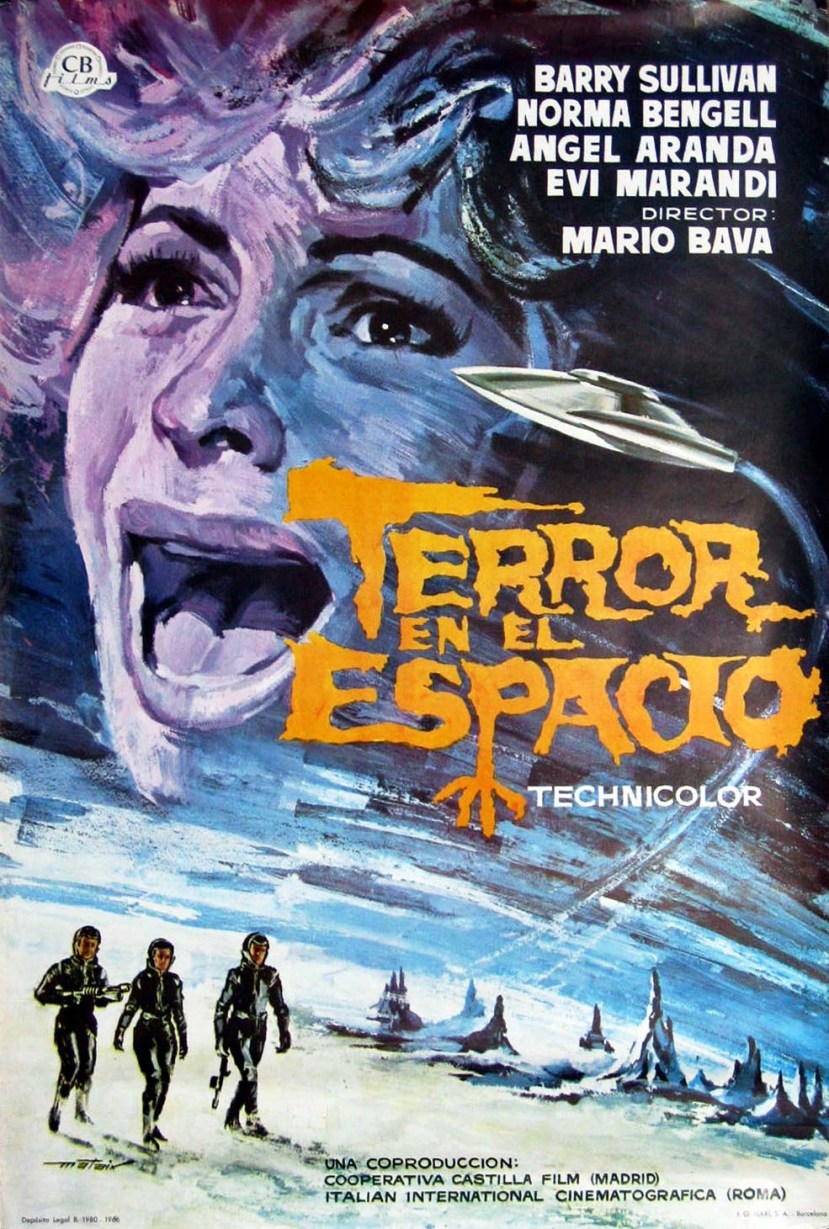
Planet
of the Vampires
1965
Director- Mario Bava
Cast- Barry Sullivan, Norma Bengell, Ángel Aranda, Evi
Marandi, Franco Andrei, Federico Boido,
From Italy
A pair
of spaceships, the Galliott and the Argos, have traveled from Earth to
investigate a signal coming from a planet that defies exploration via
traditional long range methods. Upon nearing the planet, both ships are pulled
down with such astounding G force that both crews black out.
After
landing, the crew of the Argos begins to regain consciousness and they all seem
to have gone insane, fighting and trying to kill each other. Only the Captain,
Mark, (Barry Sullivan) seems to have retained his sanity. He subdues the crew
members one at a time and they come to their senses with no clue as to the
origin of their recent murderous behavior.
After
gathering themselves, Mark and the members of his crew set out to explore the
strange world on which they’ve landed. The landscape is alien and foreboding; strange
rocks, fog, a dim glowing horizon. Eventually they find the crew of the
Galliott. They’re all dead, apparently having murdered each other in a fit of
madness.
.jpg)

After burying
their dead, the crew of the Argos come upon the wreckage of an ancient
spaceship and the skeletons of its previous crew; humanoids three times the
size of a human. Before they can solve this mystery they are confronted with an
even bigger one: the crew of the Galliott are rising from the grave!
They discover that they are on a planet of vampires, though these vampires exist as energy beings. Their planet is dying and they have lured the Earthlings in order to secure a way off of their world. They drove the crews to murder so that they could inhabit the lifeless husks. Their goal is to steal the spaceships and find a new world with lots of bodies that they can take over. Of course, Mark and the crew of the Argos must do everything in their power to stop them.
.jpg)

On its
surface, the film appears very different from Mario Bava’s better known gothic
works like Black Sunday or Black Sabbath. However, the aesthetic differences
aside, this is very much a macabre movie and Bava’s influence can be felt.
The film
is often cited as having been very influential on better known films like
Ridley Scott’s Alien. I don’t think there is anything plot wise that the two
films share, but the scene with the giant alien corpse in the derelict from
Alien was definitely taken from the same scene in Planet of the Vampires. Supposedly,
the movie was also very influential to the upcoming Aquaman sequel, but that is
still at least 10 months away, so we’ll have to wait and see.
Even if the film had nothing
else to offer, being an influence on Alien should make it mandatory viewing for
any true science fiction fan. The film does have something else, however, that
makes it worth watching and that is a truly unique aesthetic. Rather than going
for realism ( after all astronauts had already gone into space by 1965) the
movie opts for style. But it eschews the orderly military look of Forbidden
Planet or the brightly colored attire of Lost in Space (which came out at the
same time as Planet of the Vampires). The crew here is decked out in head to
toe leather. They look more like members of the MFP in Mad Max than space
explorers. It’s a truly unique look designed for visual effect rather than believability.
.jpg)

As for visual effects, well
the movie has a low budget and it shows. In this case though, I think that the
low budget helps rather than hurts. With an extravagant budget, Bava might have
been tempted to go down the rabbit hole of FX like so many other directors. I
imagine, if you are a creative person, it must be tempting to see what you can
do with vast resources at your disposal. In Planet of the Vampires, however,
Bava has to get by on production values that seem to be just below an episode
of Star Trek. I think this forced Bava to focus more on mood and it shows in
the eerie alien landscape. It should also be pointed out that even low budget
movies, in those days, still had to build actual sets. Today the whole thing
would be green screened and could be shot in someone’s bathroom.
If you want a scare or a
clever script with lots of twists and turns, this is not the film for you.
However, if you are a fan of classic sci-fi, Italian cinema, or Italian horror,
then you should view the film at least once to see a great example of genre
film making from that period. Beyond that, I recommend the film to anyone who
wants to see a really creative, slightly bizarre, take on an old theme.
.jpg)
.jpg)