Tuesday, May 12, 2020

Liquid Sky


Liquid Sky
1982

Director- Slava Tsukerman
Cast- Anne Carlisle, Paula E. Sheppard, Susan Doukas, Otto von Wernherr, Bob Brady, Elaine C. Grove, Stanley Knap, Jack Adalist
            
     Set in the New Wave scene of early 80s New York, Margaret is a drug addicted fashion model (Anne Carlisle in her most famous role). She is sexually ambivalent and emotionally unattached to anyone except her uncaring girlfriend (Paula E. Shepard). Her arch rival in the local modeling scene is the androgynous (and also drug addicted) Jimmy (also played by Carlisle).


 Margaret, because of her drug use and associations, finds herself in some pretty dangerous sexual situations including getting raped in front of her own apartment. Jimmy meanwhile is the ultimate user, manipulating people to further his addiction.

Amidst all of this, tiny aliens (their space ship is no bigger than a dinner plate) have come to prey on the junkies in the club scene. The aliens live off of the chemicals that the human brain produces during extreme pleasure, like say during an orgasm or after a shot of heroin. The aliens take up residence on the roof of Margaret’s apartment building. Margaret carries on a loveless sexual relationship with her old college acting professor and as he is orgasming the aliens kill him, sucking out his brain chemicals in an instant. The only evidence they leave behind is a crystal shard sticking out of his head.

Margaret doesn’t know what has happened or why but the last thing that someone in active addiction (who doesn’t think too highly of people anyway) is going to do is call the cops, so she decides to hide the body. Later, another one of her high risk encounters has yet another guy rape her, except this time the rape ends with him dying as he climaxes, with the tell-tale crystal sticking out of his head. Margaret puts two and two together and comes to the wrong conclusion. Knowing nothing about the aliens, she concludes that she is somehow killing people by having sex with them. Margaret is immune to the aliens as she never reaches orgasm (either from her drug addiction or depression I’m not sure). She decides to turn the tables on some folks, using sex as a weapon to get rid of some people.

This movie’s subject matter was very ahead of its time. It gets pretty detailed (for a movie) talking about opiate receptors in the brain and how heroin and sex work the same way on the brain. When this film was made, there was not a widespread understanding of the neuropharmacology of addiction (even today most medical doctors who don’t work in the field have only a vague understanding of addiction). Most Hollywood portrayals of addiction were either the comical town drunk or the tragic dope fiend and those films certainly wouldn’t have taken the time to explain neurological processes.

Also, either the writer or somebody closely involved in the making of this film had an intimate understanding of addiction. Not because the depictions of drug use are so accurate (we see very little of the actual drug use in the film) but the addict behavior is spot on. Margaret is apathetic to the point of self-destruction. Ambivalence seems to be her coping skill for life. She gets treated like crap, used and abused, but she goes on about her way, glamorous image intact, with the detachment of someone who has accepted that it won’t stop raining anytime soon. Jimmy, meanwhile, is not above any manipulation, threats or charm, to get what he wants, such as a scene where he as lunch with his mother. They have a pleasant conversation all the way through until at the end when he quickly slides in a request for money.

But none of that is what the movie is known for. It’s known for its look.  The images of the film are so iconic and the film was so influential on a particular subculture that it’s hard (looking back almost 40 years later) to figure out how much of the film was displaying New Wave /post punk culture and how much it was creating said culture. Margaret and Jimmy’s pale, androgynous look prefigured the “heroin chic” look of 1990s.

As it takes place in the world of fashion, there are plenty of eye catching visuals. But the beautiful faces and bright colors, rather than cheering you up, just serve as a counterpoint to highlight the grim nature of the film, And grim it is. The fatalistic nature of addiction aside, the film offers a pretty pessimistic view of humanity. Everyone is out for themselves. Everyone is mean to everyone else. Margaret is the most likable person in the film mainly because her abuse is turned inward instead of outward.  The musical score, rather than the synth pop you’d expect, is industrial marches bordering on atonal and cacophonous. I have to assume that the grim nature of the film was informed by the maker’s backgrounds. The director Slava Tsukerman and cinematographer Yuri Neyman had both emigrated from the USSR prior to making this film. Something about Eastern Europe made it the perfect fit for the New Wave scene (case in point, Berlin of the 1980s).

The film looks low budget (which it was) but it doesn’t look cheap. Though there are no big name actors or impressive special effects, every bit of the film looks like it was made by consummate professionals who had a very specific final product in mind. If the last time you saw this film was after renting it from a video store, there is a new digitally restored version available on Blu-ray. If you haven’t seen it, and are open to the avant-garde, then you might enjoy this intersection of art, science fiction, and social commentary.


Saturday, May 2, 2020

The Aztec Mummy Trilogy


The Aztec Mummy Trilogy

1957
Director- Rafel Lopez Portillo
Cast-  Ramón Gay, Rosa Arenas, Crox Alvarado, Luis Aceves Castañeda, Ángel Di Stefani, Arturo Martínez
            
     This is a trilogy of movies, all directed by Rafel Lopez Portillo, using the same cast and directed at the same time in 1957. Viewed sequentially they form a single story that centers around a centuries old, Aztec mummy.

The Aztec Mummy (La Momia Azteca)
            
     The story begins with a warning about a supervillain called The Bat who is known to conduct strange experiments on animals. Meanwhile, Dr. Eduardo Almada has been developing a process of hypnotic regression where he can get a person to recall events from a past life. He is appropriately scoffed at by the scientific community and feels disheartened. But what does this have to do with a mummy? Well just wait.
       
   
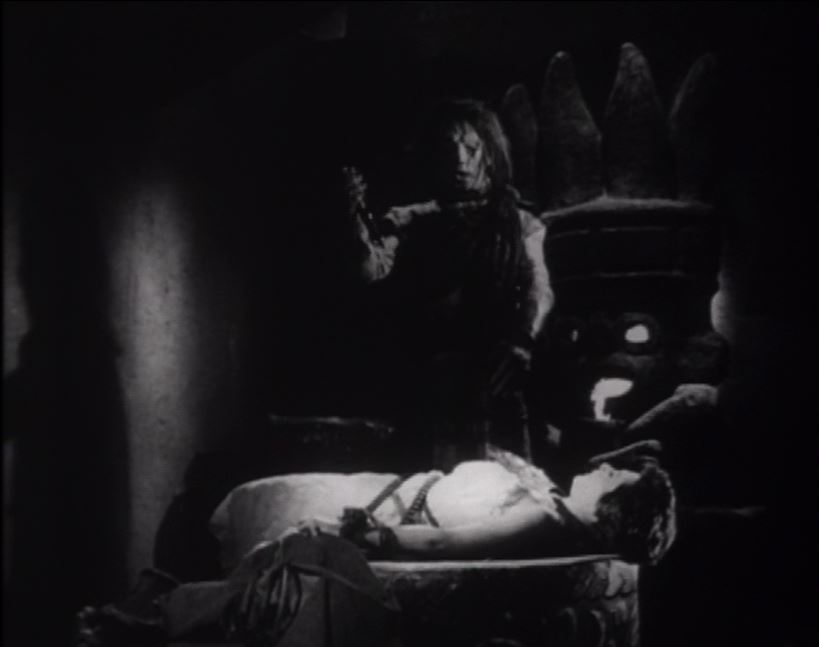
     In a burst of inspiration, he decides to hypnotize his fiancé Flor. Through hypnosis, Flor recalls an astounding memory. Centuries before, Flor was an Aztec maiden named Xochitl. She was to supposed to maintain her virginity so that one day she could be sacrificed to the gods. Unfortunately she bucks tradition and falls in love with a warrior, Popoca. She and Popoca upset the local priests when they consummate their relationship. As punishment, Popoca is forced to drink a potion that drives him insane. Xochtiti is ritually murdered and a golden breastplate and bracelet are placed on her corpse.  OK, but where is the mummy?
            

     Before we get to that, this is the point where we need to make sure that you are acquainted with Mexican horror.  Mexican horror is not like other western horror. It’s not even like Spanish horror. Mexican horror doesn’t have the internal consistency that viewers come to expect from traditional horror subgenres. As a result, it can be both bizarre and fun. It’s closer to American horror than European but with much less rules. For instance, science fiction and horror are rarely mixed and when they are mixed its usually just scary science fiction involving aliens. Rarely does American horror combine science fiction with something truly supernatural.  Mexican horror, on the other hand, will combine all sorts of genres with little thought as to whether or not they “should” go together.
            

     Dr. Almada knows that in order to prove his theories he’ll have to have something to back up his story. So using information from his wife’s recently retrieved past life memory he takes her and his cowardly friend Pinacate to an Aztec temple and starts looking for a tomb. There, Flor comes face to face with herself and finds the corpse of Xochitit, now just a skeleton. They take the breastplate from her corpse and then head out. Unbeknownst to them though, this has woken up Popoca who was cursed to be a mummy and guard the tomb (finally!).
            

     The doctor presents the breastplate to the scientific community and they (rather unscientifically) accept this as proof of his theories about past lives. The breastplate contains inscriptions that are supposed to lead to a vast treasure but unfortunately one has to have the bracelet to decode it. Dr. Almada decides he’ll go back to the tomb but the other scientists (again rather unscientifically) warn him about the dark powers that guard it. He scoffs at their fears as mere superstition, which is weird considering the things he has already proven to be true. He has proven the existence of past lives that can be accessed through hypnosis, but a mysterious curse is just a bridge too far for him I guess.
            
     Flor objects to all of this and chimes in as well about the dark powers. But this was the 1950s and I guess no woman’s objections were going to get in the way of science. The doctor goes back to the tomb and comes face to face with the mummy and runs home with his tale between his legs.
            
     But The Bat meanwhile (almost forgot about him didn’t you) has been monitoring the whole situation because he is actually one of the scientists that has been scoffing at the doctor. He sends his henchman, Tierno, to the doctor’s house to steal the breastplate. Tierno, by the way, means “tender” in Spanish, which is a terrible name for a villain. Popoco the mummy, however, is also on his way to the good doctor’s house for the same purpose. Tender runs into the mummy and retreats. When he tells The Bat what happened, The Bat thinks he is full of crap. Again, The Bat is willing to accept everything else but not The Mummy? You have to remind yourself that this is Mexican horror.
            

     Popoca gets his breastplate and decides to kidnap Flor while he is at it. He takes her back to the tomb with the intention of re-enacting her ritual sacrifice. The Bat, meanwhile gets caught by the police while giving chase. Dr.Alamada, Pinacate, and Flor’s father save Flor from the mummy. Her father uses a crucifix to keep it at bay. Why a crucifix would work on an Aztec mummy, I have no idea. Fortunately, he also uses a stick of dynamite which, though killing him in the process, traps Popoca in his tomb.
            
     The movie only has one drawback. Most of the mummy’s scenes take place in the dark and the lighting is so poor, it’s hard to get a good look at it. But the mummy isn’t really the star anyway, more of a plot device.


The Curse of the Aztec Mummy  (La Maldición de la Momia Azteca)
           
     This movie picks up right where the last one left off (after about 20 minutes of recap). The Bat, after being arrested in the last film, is being transported to prison. His crew ambushes the transport and a shootout ensues. A caped, roadster driving, masked luchador, The Angel, intervenes. Yes, a masked wrestler has now entered our tale. Remember, I told you, this was Mexican horror.
            
     The Angel gives the bad guys what for but in the end there are too many of them. He is subdued and The Bat escapes. He still has his sights set on the Aztec treasure and wants that breastplate. But he doesn’t know where in the tomb it was located. Well, if Dr. Alamada can hypnotize Flor to get it, then The Bat can too! He kidnaps her and gets his hands on the breastplate and bracelet. He holds Flor hostage and forces Dr. Alamada to start working on translating the inscriptions.
            

     The Angel intervenes and is beaten (he doesn’t seem to be a very good superhero). He gets stuck dangling over a pit of snakes and escapes in time to get captured again. His mask is removed (the nightmare of every luchador) and we find out that he is actually the supposedly cowardly Pinacate. The doctor finishes the translation and The Bat is about to kill them when Popoca the mummy shows up and wreaks havoc. The henchman, Tender, gets acid splashed on his (they are in a villain’s hideout after all and such things are often left lying around). The Bat falls in the aforementioned pit of snakes and Popoca, in possession of his treasure again, goes on his way. Everyone can now live happily ever after. Or so it seems.


The Robot vs. the Aztec Mummy (La Momia Azteca contra el Robot Humano)
            
     Volume three picks up five years after the last film (after another 20 minutes of recap). Pinacate (his identity revealed) has abandoned his charade of The Angel. The Bat, though, has not abandoned his dream of the Aztec treasure. You can say this for him, the man is goal oriented. He needs two things; to know where Popoca (and his breastplate) have disappeared to and a way to beat him. Tender, though, just wants revenge for his acid burned face.
            
     The Bat theorizes correctly that Flor and the mummy have a psychic connection. Since The Bat has hypnotized her before, he can exert remote control over her. She sleepwalks out of her home and takes The Bat to a cemetery where Popoca is resting. She then goes home and wakes up the next morning, none the wiser.
            

     The Bat kidnaps everyone again, and again steals the breastplate, but this time he is prepared. Remember at the beginning when I mentioned those weird medical experiments. Well, that finally comes into play. The Bat has stolen a human head and placed it inside a robot (which I guess, technically makes it a cyborg). This atomic powered abomination is meant to protect him against Popoca. When the mummy shows up, it’s initially a good fight, but in the end, supernatural vengeance trumps any man made monstrosity. Evil is finally vanquished. Popoca can finally be left alone with his breastplate and Flor can live out her life without anyone else trying to kidnap or hypnotize her.
            

     Viewed all together, the entire trilogy is about 3 and half hours long (assuming that you don’t skip through the 40 minutes of recap). This is a crazy series typical of the fun that can be found in Mexican horror if you’re willing to put logic aside and just take things at face value. It’s not as classic as say, the Santo series, but still fun to watch. Actually, I think a modern remake by Guillermo del Toro could be very entertaining.

Side note: Several other Mexican movies would later use the idea of an Aztec mummy, most notably Wrestling Women vs. the Aztec Mummy (1964), but none of these films are related to this trilogy. For a similarly fun if not quite so eclectic story, check out the American serial, The Crimson Ghost.


Thursday, April 30, 2020

Shadowplay


Shadowplay

2019

Director- Tony Pietra Arjuna
Cast- Tony Eusoff, Juria Hartmans, Iman Corinne Adrienne, Khairil M. Bahar, Ayez Shaukat Fonseka Farid, Stephen Rahman Hughes, Tehmina Kaoosji, Radhi Khalid, Susan Lankester, Benedict Ly, Riki Rikando, Megat Sharizal, Jay Sheldon, Chacko Vadaketh

From Malaysia
            
    Anton (Tony Eusoff) is an aspiring private detective who likes to read detective novels. He specializes in finding rare objects but gets a job finding a missing girl. He has an emotional interest in this case as he himself was once a missing person. He only has a vague recollection of it but has scary memories of a creepy looking man dragging a frightened girl away from him.

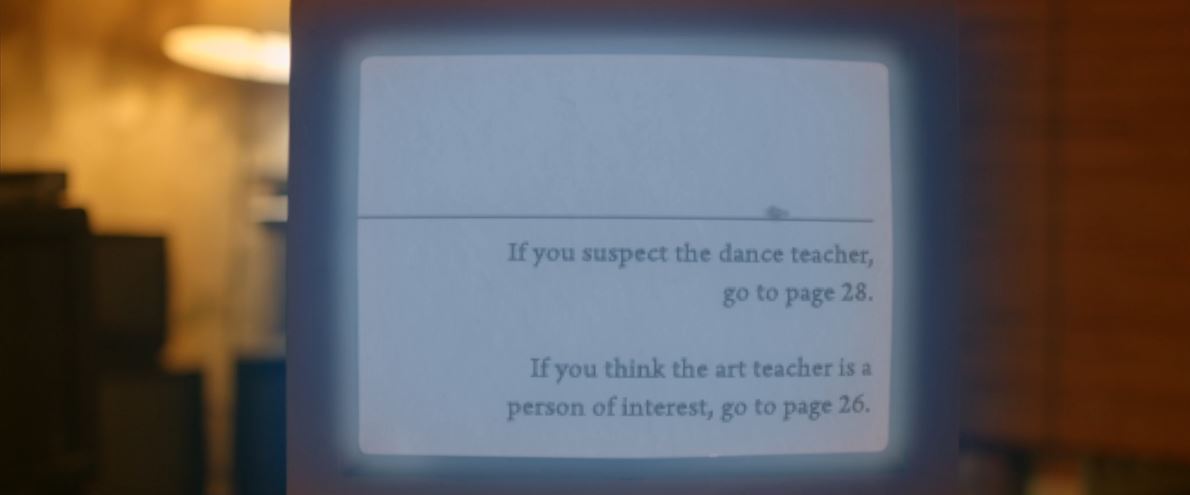
He gets his hands on a rare novel, Adieu Syangku, and it seems to be giving him clues to solve the case. The novel reads like a “choose your adventure” book. However, some of the choices lead to death, which he finds out when one of the suspects kills him! Except he’s still alive, reading the novel, and picks a new option. It’s at this point that you start to realize this is not a straight forward narrative.  His clues lead him to the people who kidnapped the missing girl and he realizes that the case is related to his own childhood disappearance.

There are a lot of different influences evident in this film, both narratively and visually. The movie is definitely surreal, not as much as say, a Jean Rollin film, but about on par with a David Lynch film. The movie operates within its own set of rules that aren’t the same as the real world. Time is a relative concept and some things that have happened undo themselves and happen again differently. Like a dream, it makes sense in the dream, and only after waking does the irrationality become evident.

There is also some Michael Mann influence in there as most of the movie takes place at night, in the city. The city doesn’t take on its own personality like in a Mann film, but effort is made to incorporate the cityscape into the story telling. The visuals are very interesting. The color palette isn’t as vibrant as Suspira but it does present a lot of bold images with contrasting, bright colors that are both beautiful and jarring.

My knowledge of Asian horror is not as extensive as that of Western horror, and what I mainly know are the films from Hong Kong and Japan. My knowledge of Southeast Asian cinema was limited to low budget movies from the 80s and 90s like Lady Terminator and Dangerous Seductress.  Shadowplay definitely benefits from, and takes advantage of, the new era of digital film making. It looks as good as any bigger budget Western film, but it still has that different take on things that make Eastern movies interesting. I also have to say, I liked the “choose your adventure” plot device. I had some of those books as a kid and they gave me countless hours of enjoyment.

I’d say broadly that this movie would be classified as horror but really it’s dark fantasy. Check it out if you want something interesting and don’t mind the absence of a straight forward narrative.